王义松

开通时间:..
最后更新时间:..
扫描访问手机版
点击次数:
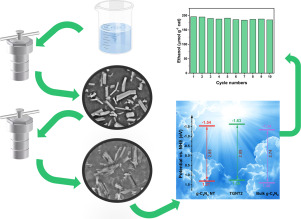
摘要:The novel composite photocatalyst of trimodal porous silica (TPS)/gC 3 N 4 nanotubes was fabricated via a two-step hydrothermal synthesis method with intermediate pretreatment. The TPS was extracted from rice husk, which is agricultural waste, to further reduce the cost of photocatalyst preparation. A series of characterization results, including X-ray diffraction, Fourier transform infrared spectroscopy, X-ray photoelectron spectroscopy, scanning electron microscopy, N 2 adsorption–desorption, and pore size analysis, illustrated the properties of crystal, pore structure, and morphology of the composite photocatalyst. The TPS/gC 3 N 4 presented a hollow tubular shape with a large surface area and CO 2 adsorption capacity, so there were more catalytic active reaction sites. The photocatalytic activity measurement was operated, and only ethanol was detected when gC 3 N 4 NT and composite TGNT were used as photocatalysts. In particular, the ethanol yield of TGNT2 was 196 μ m/g, and after 10 cycles of running, the photocatalytic activity decreased by less than 5%. UV–Vis diffuse reflectance spectra, photoluminescence spectra, and photoelectrochemical analysis revealed the mechanism of the photocatalytic activity enhancement from the aspects of visible light absorption, photo-generated electron–hole pair separation and transfer, and charges recombination. It theoretically explained the prospect of this fabrication strategy. It demonstrated that TGNT is a low-cost, stable, efficient, and promising photocatalyst to reduce CO 2 to ethanol under visible light.
是否译文:否
上一条:Chen, P., Du, T.*, Jia, H., Zhou, L., Yue, Q., Wang, H., & Wang, Y.* (2022). A novel Bi2WO6/Si heterostructure photocatalyst with Fermi level shift in valence band realizes efficient reduction of CO2 under visible light. Applied Surface Science, 585, 152665.
下一条:Jia, H., Du, T.*, Fang, X., Gong, H., Qiu, Z., Li, Y., & Wang, Y.* (2021). Synthesis of template-free ZSM-5 from rice husk ash at low temperatures and its CO2 adsorption performance. ACS omega, 6(5), 3961-3972.
