
 石晶晶

|
个人信息Personal Information
副教授
博士生导师
硕士生导师
教师拼音名称:shijingjing
所在单位:医学与生物信息工程学院(中荷生物医学与信息工程学院)
学历:博士研究生毕业
联系方式:
学位:博士
在职信息:在职
毕业院校:名古屋工业大学
所属院系:医学与生物信息工程学院(中荷生物医学与信息工程学院)
学科:生物医学电子
1. Magnetic Metasurface-Assisted Dual–Mode Coil–Antenna System for Wireless Brain–Computer Interfaces
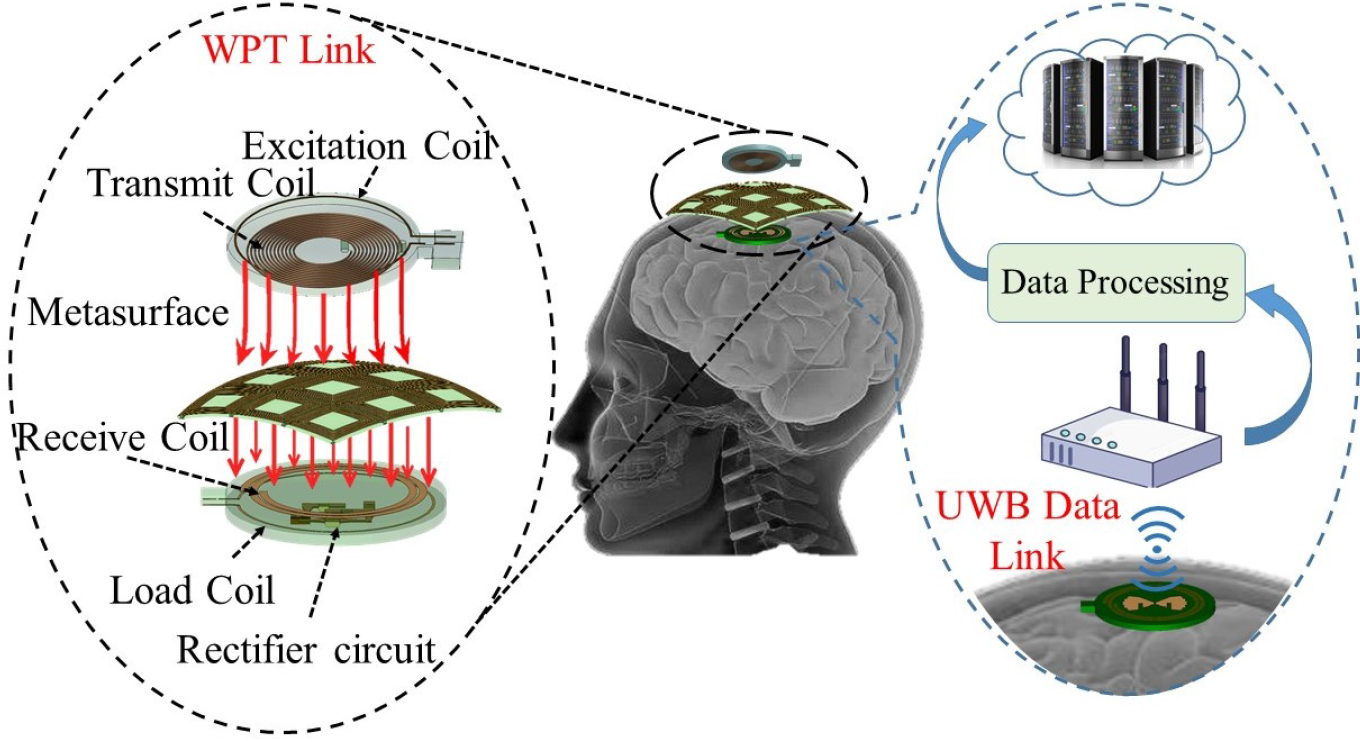
Wireless brain–computer interface (BCI) systems represent an important class of implantable medical devices (IMDs) for continuous neural monitoring and intelligent medical applications. However, achieving efficient wireless power transfer (WPT) and broadband data transmission within a compact and safe implantable architecture remains challenging due to stringent size constraints, misalignment sensitivity, and energy conversion limitations. To address these challenges, a magneticmetasurface-assisted dual–mode coil–antenna integrated system is proposed for integrated WPT, RF-to-DC rectification, and ultra-wideband (UWB) telemetry. The proposed architecture combines a 40 MHz four-coil resonant WPT link with a 3 × 3 magnetic metasurface array to enhance magnetic-field focusing and improve robustness against lateral displacement and angular misalignment. A voltage-doubler rectifier is further integrated and optimized for efficient RF-to-DC conversion, thereby establishing a complete wireless power transfer and rectification chain.
2. Wearable AMC-Based Multimodal Antenna Sensor With GA-BP Network for Plantar Health Monitoring
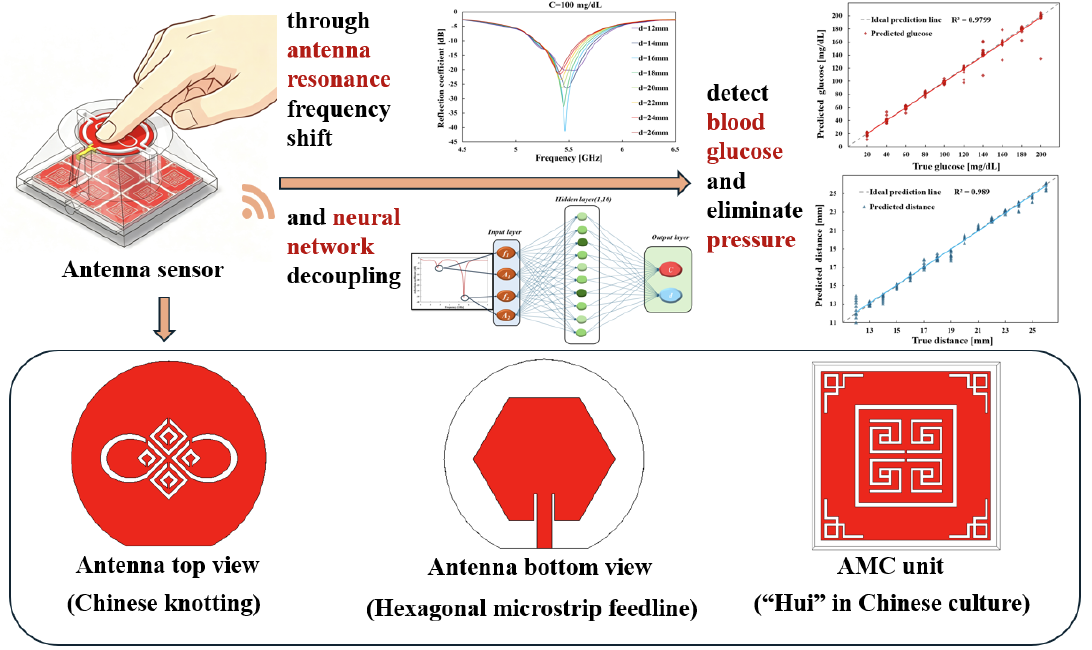
Microwave non-invasive blood glucose sensing offers a promising approach for fingertip-based detection. However, contact pressure during measurement causes tissue deformation and impedance drift, which obscures faint blood glucose signals. To address this issue, this paper proposes a dualband complementary split-ring resonator (CSRR) antenna sensor with an artificial magnetic conductor (AMC) backplane, combined with a Bayesian-regularized backpropagation neural network (BP-BR) to eliminate contact pressure interference. The sensor consists of a four-cell“Chinese-Knot” CSRR patch, a matched “Huipattern”AMC reflector, and a compressible lowpermittivity spacer. Upon fingertip contact, the spacer converts contact pressure into clearance variations between the CSRR and the AMC, enabling the electromagnetic response to contain both glucose-induced dielectric information and pressure-induced interference. Loading the AMC effectively eliminates the amplitude refolding observed in standalone antenna measurements and achieves strict monotonicity, and furthermore enhances sensing performance under varying contact conditions. To address contact pressure interference, a four-dimensional electromagnetic feature vector (f1, A1, f2, A2) is extracted from the responses under varying contact conditions and evaluated with five regression models using random five-fold crossvalidation. The proposed hardware-software synergistic design strategy provides a robust solution for compact and portable non-invasive blood glucose detection instruments, advancing RF sensing technology toward practical metabolic monitoring.